Halide perovskite-based metasurfaces: structure design, performance regulation, and optoelectronic applications
SHANNON, CLARE, IRELAND, October 13, 2026 /EINPresswire.com/ -- Announcing a new publication from Opto-Electronic
Press Release Disclaimer: This is a press release distributed through the XPR Media network. It has not been independently verified by our newsroom.

SHANNON, CLARE, IRELAND, October 13, 2026 /EINPresswire.com/ — Announcing a new publication from Opto-Electronic Manufacturing; DOI 10.29026/oem.2026.260001.
Halide perovskite metasurfaces combine the precise light-control capabilities of nanostructured surfaces with the active optical and electronic properties of perovskite materials. A recent review by Prof. Tun Cao’s group summarizes their structural designs, tuning mechanisms, and emerging optoelectronic applications. The work highlights two major development routes and discusses their potential in displays, lasers, photodetection, imaging, solar cells, optical communications, quantum optics, and integrated photonic systems.
Light is one of the most important carriers for acquiring and transmitting information. From smartphone displays and high-definition imaging to optical communications, LiDAR, medical imaging, and intelligent sensing, many modern technologies ultimately depend on how light can be generated, detected, and controlled. Conventional optical systems usually rely on lenses, prisms, polarizers, and other components to change the direction, phase, or polarization of light. However, these components are often millimeters or even centimeters in size. As information technologies move toward miniaturization, integration, and multifunctionality, compressing complex optical functions into thinner and smaller devices has become an important goal in modern optics and optoelectronics.
Metasurfaces offer a promising solution. They can be understood as artificial optical surfaces made of large numbers of nanoscale structures smaller than the wavelength of light. By carefully designing their shape, size, arrangement, and orientation, these tiny structures can control the amplitude, phase, polarization, and propagation direction of light. Functions that once required several conventional optical elements can therefore be integrated into a single ultrathin layer. For this reason, metasurfaces have attracted broad interest in flat lenses, beam shaping, polarization control, holographic displays, and integrated optics.
Traditional metasurfaces, however, still have limitations. Many are made from dielectric materials such as silicon and gallium nitride or from metals such as gold and silver. These structures are highly effective at controlling existing light, but they generally lack intrinsic optical gain and active optoelectronic responses. If a device is required to change its behavior in response to light, voltage, or temperature, additional functional materials and more complicated device architectures are often needed. Metallic structures may also introduce relatively high optical losses.
Halide perovskites provide a new material route from passive light control toward active optoelectronic regulation. These materials offer strong light absorption, high luminescence efficiency, tunable bandgaps, and good carrier transport properties. Their refractive index, electrical conductivity, and emission characteristics can also respond to external stimuli such as light, electricity, and temperature. In addition, perovskites can potentially be processed from solution over large areas and are compatible with a variety of micro- and nanofabrication techniques.
When perovskites are combined with metasurfaces, the two platforms become highly complementary. Metasurfaces provide precise control of local optical fields, propagation, polarization, and wavefronts, while perovskites contribute emission, absorption, optical gain, nonlinear responses, and active tunability. This combination allows metasurfaces to move beyond predominantly static light control toward active platforms that integrate optical manipulation with optoelectronic response. With continuing advances in nanofabrication, materials processing, and light-matter interaction, perovskite metasurfaces have expanded from early studies of emission enhancement and optical-field localization to bound states in the continuum, exciton-polaritons, topological photonics, dynamic light-field control, and integrated optoelectronic devices.
The research group of Prof. Tun Cao from the School of Optoelectronic Engineering and Instrumentation Science at Dalian University of Technology systematically reviewed recent progress in the structural design, performance regulation, and optoelectronic applications of halide perovskite metasurfaces. The work, entitled “Halide perovskite-based metasurfaces: structure design, performance regulation, and optoelectronic applications” was published in Opto-Electronic Manufacturing in 2026.
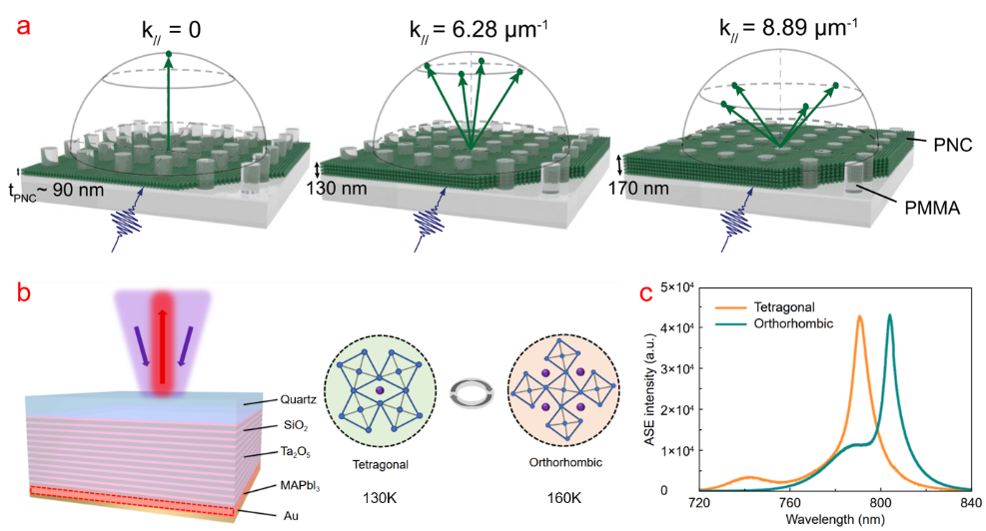
The review organizes the field into two major technological routes. In the first, perovskites are integrated with conventional metallic or dielectric metasurfaces. The nanostructures enhance local optical fields and light-matter interactions, while the perovskites provide strong emission, absorption, nonlinear optical responses, and dynamic tunability. In the second route, the perovskite itself is directly patterned into subwavelength structures such as nanopillars, nanodisks, or gratings. In this way, the same material can perform both light manipulation and optoelectronic conversion, supporting more compact and highly integrated devices.
The review further summarizes important physical mechanisms including Mie resonances, bound states in the continuum, strong light-matter coupling, and dynamic regulation induced by light, electricity, temperature, and compositional changes. It also discusses applications in light-emitting diodes, lasers, photodetection and imaging, perovskite solar cells, optical communications, quantum optics, and optical computing.
For everyday life and society, these technologies could contribute to thinner displays with improved color and directional control, more sensitive imaging and environmental sensors, faster and lower-power optical communication systems, and more highly integrated photonic chips. In the energy field, precise control of light by metasurfaces may also improve light utilization and operational stability in solar-energy devices.
The review also points out that several challenges must be overcome before large-scale practical deployment becomes possible. These include the long-term stability of perovskite materials, large-area and high-precision fabrication, device-to-device consistency, optical loss, electrical driving, and system-level integration. Looking ahead, advances in more stable perovskite materials, scalable fabrication techniques such as nanoimprint lithography, and integrated photonics may enable perovskite metasurfaces to overcome the relatively fixed functionality of conventional optical devices. Ultimately, light emission, light-field manipulation, photodetection, and dynamic response could be integrated within the same nanoscale platform, providing new routes toward reconfigurable displays, intelligent sensing, next-generation optical communications, and highly integrated active optoelectronic systems.
Keywords: halide perovskite, metasurfaces, optoelectronic modulation, light-matter interaction, dynamic tuning
# # # # # #
Prof. Tun Cao is a professor and doctoral supervisor at Dalian University of Technology. He is Dean of the School of Optoelectronic Engineering and Instrumentation Science and Deputy Secretary of the Party Committee. He is a member of the Academic Degrees Committee of the State Council for Nanoscience and Engineering and a Liaoning Academic Leader. He serves as Deputy Director of the Liaoning Key Laboratory of Advanced Optoelectronic Technology and Director of the Dalian Key Laboratory of Novel Functional Materials and Optoelectronic Devices. He is also a member of the Extreme Manufacturing Branch of the Chinese Mechanical Engineering Society and a Fellow of Optica.
Prof. Tun Cao has received nine provincial- and ministerial-level or higher science and technology awards, including the First Prize of the Military Science and Technology Progress Award, First Prize of the Liaoning Provincial Technological Invention Award, Second Prize of the Natural Science Award of the Ministry of Education, First Prize of the Technological Invention Award of the China General Chamber of Commerce, and Special Prize of the Liaoning Provincial Teaching Achievement Award. He has published more than 140 SCI papers as first or corresponding author in journals including Science Advances, Advanced Materials, Physical Review Letters, and Light: Science & Applications, with 5,440 citations. He holds more than 60 authorized international and domestic invention patents, with two achievements transferred.
The group is based at the Liaoning Key Laboratory of Micro/Nano Optoelectronics and Intelligent Sensing and focuses on the integration of micro/nano optoelectronic materials, structures, and functions. It has undertaken more than 30 projects, including National Key R&D Program projects, international cooperation projects, National Natural Science Foundation projects, and aerospace enterprise commissioned projects. More information is available on the group’s university webpage (http://faculty.dlut.edu.cn/2010011065/zh_CN/index.htm).
# # # # # #
Opto-Electronic Manufacturing (OEM) is a peer-reviewed, open-access journal within the Opto-Electronic Journals Group. It bridges fundamental research and engineering practice to promote advanced manufacturing, turning technological innovation into tangible industrial impact.
# # # # # #
More information: https://www.oejournal.org/oemanuf/
Editorial Board: https://www.oejournal.org/oemanuf/en/editorial_board/oemEditorialBoard
All issues available in the online archive: https://www.oejournal.org/oemanuf/archive
Submission of OEM may be made using ScholarOne https://mc03.manuscriptcentral.com/oem2026
ISSN 3136-8301
Contact Us: oemanuf@ioe.ac.cn
Twitter: @OptoElectronAdv (https://twitter.com/OptoElectronAdv?lang=en)
WeChat: OE_Journal
# # # # # #
Liu JX, Su Y, Gao ZB et al. Halide perovskite-based metasurfaces: structure design, performance regulation, and optoelectronic applications. Opto-Electron Manuf 1, 260001 (2026). DOI: 10.29026/oem.2026.260001
Opto-Electronic Manufacturing Editorial Office
Opto-Electronic Manufacturing
+ +86 591 2286 1222
oemanuf@ioe.ac.cn
Legal Disclaimer:
EIN Presswire provides this news content “as is” without warranty of any kind. We do not accept any responsibility or liability
for the accuracy, content, images, videos, licenses, completeness, legality, or reliability of the information contained in this
article. If you have any complaints or copyright issues related to this article, kindly contact the author above.

Media gallery